[
In 2013 a distress call revealed a whale was foundering off San Francisco. A rescue boat was dispatched, and, finding that the whale was caught in a web of ropes and nets, the intrepid crew decided to plunge in and try to cut them away. They succeeded, and the grateful whale joyfully thanked each of her rescuers with a personal nudge. Minds well and truly met. The rescuers were moved. In the 21st century this kind of story is not unique. As a massive species die-off proceeds due to our inexorable activities, evidence of friendship with fellow sentient beings evokes a timely nostalgia.
In the 18th and 19th centuries, such an encounter would have had ended differently. In Melville’s day the distressed whale would have been finished off, towed into harbor, butchered and her blubber boiled down to oil. Of course she wouldn’t likely have been caught in that tangle in the first place. Captain and crew would have been thankful, in a moment of spiritual contentment, that a business-friendly Calvinist God positioned them to profit from the encounter.
Does this denote the long arc of the moral universe bending toward the good?
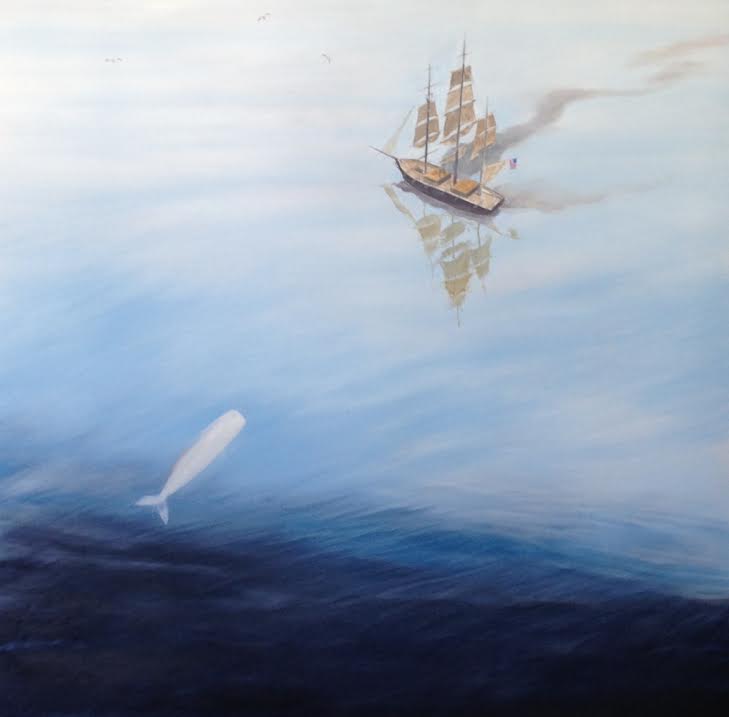
Societies and individuals can choose, as the crew of the Pequod did not, to survive. Were not Ahab’s deranged imperatives and manipulations pulling them toward the vortex of their doom, like Hitler’s Germany or Tojo’s Japan or the carbon corporations with their denialist media juggernauts of the present? Only with eyes wide open will crews and societies have the capacity to mobilize a struggle to change course. Doing it earlier rather than later is preferable: in complex systems it might be that the ship has already been hit by Moby-Dick (climate), but the consequences are perceived as merely episodic (extreme weather). We know very well that corrective action is urgently needed.
History and time are now condensed by our instant access to so much of it, prompting information cascades that make for fog-of-war and extended periods of indecision. Conservatives, guardians of the conflicted imperatives of rapacious corporate power and moralistic cultural continuity, are not equipped to navigate the new condensed information and cultural proximities, but default angrily to the less confusing or contradictory filter sets of simpler times.
Even quite late in Moby-Dick, on doomsday itself, crew members could have said no to death, thereby getting back to their loved ones to make more babies. With the aggrieved Ahab out of action, Moby-Dick would have swung back to the harem and gotten on with life.
Having rescued the whales at least temporarily, can we not envision and coalesce a path to survival that thwarts the Ahabs and saves the planet? There are myriad possible outcomes: and many looming dystopias. In the end, Starbuck -the conscious agent- must step up, or even our witness Ishmael -the story teller- will be devoured by the leviathans of our own making.
Joe Phelan 2015
 Joe Phelan Projects